
Let’s start with some things you might not know about me…
- My first book (a young adult romance) was published in 2000, followed by a second YA at a later date. Both were written under a variation of my real name.
- M.L. Rhodes is a pen name. I’ve been using it since 2003.
- The name M.L. Rhodes actually comes from the female protagonist in one of my early romantic suspense manuscripts. Her last name was Rhodes and her initials were M.L. I always loved her name, and when I began writing straight erotic romance in 2003, I felt like I needed a pen name to keep the steamy, explicit adult stuff separate from my sweet YA books. So, because I liked it, I “borrowed” my own character’s name to use as my nom de plume.
- Why the initials instead of her full name? Because at the time I thought it would come across as cheesy if my pen name was exactly the same as my character’s full name. Using initials resolved that problem.
- In 2006, I began writing gay m/m romance. By that time I’d already been writing under under the name M.L. Rhodes for a few years and was an established author with it–M.L. Rhodes had become my “brand.” So I continued to use it for my m/m fiction. I was no longer actively writing YA by then, and it was easiest for me to publish all my adult genre books under one name.
That is the story of why I use a pen name and how the name M.L. Rhodes came to be.
I bring it up here because I’ve had many people over the years assume I chose the name M.L. Rhodes specifically to write gay male fiction, using the initials to keep my gender identity vague. The thing is, the idea of obscuring my gender never even crossed my mind when I chose my pen name. And even if I hadn’t taken a pseudonym until I began writing gay fiction, I still wouldn’t have tried to hide the fact I’m a woman. That would have been waaaay too complicated and messy for me. I have trouble remembering actual facts in my actual life. I can’t even contemplate trying to pretend to be someone I’m not in my writing life, not to mention all the subterfuge that would be involved. It’d be like a constant chess game, and I suck at chess. Besides, while I don’t do many writer conventions these days, back in my early writing years, I used to go to workshops and cons all the time (usually hauling my books with me for signings), which would have made it impossible to hide the fact I was a woman. So, nope, M.L. is just me, and I’ve never even thought of pretending otherwise. 🙂
That said…it’s common knowledge there have been authors throughout history who’ve intentionally chosen gender neutral or opposite sex pen names. Sometimes it’s done to cash in on markets primarily driven by writers of a specific gender. Sometimes it’s because authors have been warned by publishers, editors, or agents that they’ll never succeed in a genre if they don’t attempt to hide their gender. Louisa May Alcott may be best known for writing Little Women, which was published under her own name, but she used an ambiguous pen name, A.M. Barnard, when she wrote gothic thrillers that wouldn’t have been well received by a 19th century audience if they knew a woman wrote them. Thriller/horror author Dean Koontz published five gothic romances in the early 1970s under the name Deanna Dwyer in order to appeal to a genre predominantly written by and for women. But it’s not always about making more money or trying to hide one’s gender. More than a few authors take a gender-neutral name because they’re gender fluid or nonbinary in real life and they prefer using a name that represents their true self.
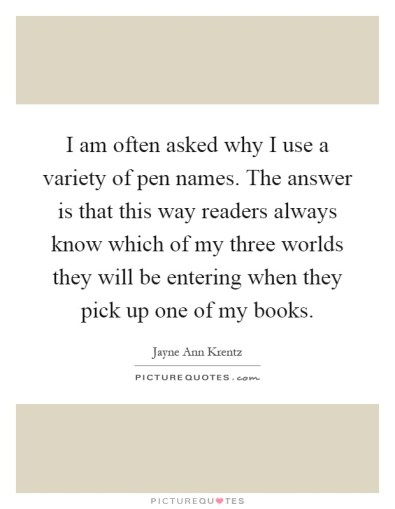
My point here is that authors choose to write under pen names (sometimes multiple pen names) for a thousand unique reasons, both personal and professional. And there are just as many reasons why they pick the specific names they do. It could be one of the reasons I detailed above, or it could be as simple as them hating their given name, or their real name is one readers might struggle to pronounce or spell (which could lead to difficult marketing). Or maybe they’ve chosen a nom de plume to protect their real-life identity. As authors, if we’re interacting on social media with thousands of followers, most of whom we’ve never met, we don’t necessarily want just anyone to know our real names because that makes it too easy for creepers to find out where we live and other intimate details about us. Another consideration is that many authors use a pen name to protect their real-life day jobs–a kindergarten teacher may be concerned about their job security if the powers-that-be at their school discover they’re writing kinky, explicit erotica by night. Or an LGBTQ author might not be out at work or at home, and they can’t afford to risk using their real name. Other authors perhaps have a spouse or partner who works in a sensitive or classified job where keeping their real identity private is critical. Or, sometimes, an author might decide to write under a pen name simply because it’s fun to set aside the daily humdrum of being John Smithers, buttoned-down accountant, for Jake Stone, action-adventure author. Picking and using a pen name can be a creative endeavor all on its own.

By far and away, most of the time an author’s decision to use a pen name is done with good intentions with no desire for harm. There are compelling reasons for authors to keep their writing identities separate from their real-world lives, and I think most readers understand and support that.
Sadly, though, there are always going to be a few rotten apples in the barrel. The LGBTQ writing community recently went through a particularly horrific incident where individuals writing under a pen name did so with the full intention of deceiving readers about not only their gender, their sexual orientation, their family and living situation, and their health, but they also cultivated personal and sometimes sexual relationships by posing as something they weren’t. Worse, they then used those experiences in the books they wrote without asking permission. They also solicited money from readers under false pretenses, and were nasty bullies when anyone even hinted they might not be who or what they said they were. It was catfishing and gaslighting at its worst because, as layer upon layer of the deception was pulled back, people were finally able to see the ugly, festering rot that lay beneath it all. Lots of people got hurt. It’s terrifying to think crap like this can happen in the real world, but it does.
Why does this particular scary tale matter, you might ask? Especially for those who weren’t personally involved and didn’t know the author or the victims? It matters because these rotten apples create a ripple effect that spreads, causing a sense of distrust in the community that hurts all readers and authors. The aforementioned catfishing author-entity was well-known and quite popular in the gay fiction community. They sold a lot of books to a lot of readers who were passionate about the stories. Finding out the author they adored, who wrote some of their most beloved characters, who seemed so real and accessible and sincere was actually a liar, a bully, and a sexual predator (among other things) was a hard emotional blow. Even for those of us who’d never had any direct dealings with this author-entity, the ripples of that betrayal hit hard, and continue to roll in. It made readers and authors alike wonder if it was safe to trust anyone anymore.
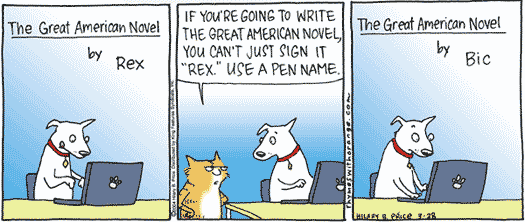
The good news is that the vast majority of authors are real people, with real lives, with no nefarious secrets. Many authors publish books using their real names and live their lives in complete transparency, after all. But even those of us who use separate writing identities are authentic in our intention to write the best books we can and engage with readers in a genuine manner. Just because someone writes under a different name from the one they use in real life, doesn’t mean the person you’re interacting with is fake. It’s hard to rebuild trust, though, and even harder when a huge chunk of the book industry is made up of authors who write under pseudonyms. How do you know who’s lurking behind that fake name?
I can only tell you what *I* know. Which is that after fifteen years, M.L. has become a part of me…she IS me. She’s the writer part of me, the storyteller, the dreamer, the creative soul. And I think that’s true for most authors. Our pen names are so much a part of us that when you’re reading our posts on social media or chatting with us, you’re interacting with the actual people we are. Our personalities and true selves shine through, regardless of what name we use. And, sometimes, readers get to see us more realistically even than our day-job co-workers or acquaintances because our creative selves are such a crucial part of what makes us…well…us. We’re not perfect, we make mistakes, some of us are quite vocal about our real lives and others keep them close to the vest. But if you’re talking to us about our books, our characters, our passion for our readers, even the most private of us will usually open up.
So, when you’re interacting with M.L. Rhodes online, you’re talking to the real me. The dragon-loving, sappy, soft-hearted, occasionally bitchy, sometimes whiny, procrastinating, proud mom, animal loving, movie-watching, geeky, sleep-deprived, introverted, night owl who would much rather be writing fantasy books about hunky dragon shifters, mermen, and witches than doing laundry or grocery shopping in the real world. 🙂
Discover more from M.L. Rhodes
Subscribe to get the latest posts sent to your email.

